Susan Turner, Chairman, Haskell County Historical Commission
Carved from the Rolling Plains of northwest Texas, Haskell County is the namesake of Charles Ready Haskell, a Texas revolutionary soldier who fell with Fannin at the massacre of Goliad.
Its 903 square miles were originally platted in 1858 from land surveyed out of Fannin and Milam counties. Its story began long before this, however, as evidenced in pre-Columbian artifacts, and battle grounds and burial sites of nomadic Indians. Seventeenth century Spanish explorers mapped “Los Brazos de Dios” – “The Arms of God” – flowing along the western border. These adventurers gave the river its name and searched its watershed for fabled treasure. Stories of wealth hidden in the shadow of Kiowa Peak are legend.
In 1849, Captain Randolph B. Marcy led an expeditionary force across northwest Texas. He crossed what would become Haskell County in the vicinity of Paint Creek. Gold seekers enroute to California followed close behind, and the Marcy Trail became a well-traveled emigrant thoroughfare. In 1871, Soldiers of the United States 4th Cavalry under the command of Colonel Ranald S. Mackenzie began a series of campaigns to remove the Indian from the northwestern frontier. From their base at Fort Griffin, soldiers and supply wagons bound for the Llano Estacado traveled along the southern border of Haskell County on what came to be known as the Mackenzie Trail. Buffalo hunters later transported thousands of hides over this trail to markets and railheads.
With the passing of the era of the Indian and the buffalo, cattlemen trailed herds across pastures rich in native grasses and clear springs. They shared the range with wild mustangs which grazed throughout the county, but especially in the western grasslands that came to be known as Wild Horse Prairie. The first permanently established cattle ranch was built in 1876-77 by J.A. Matthews and George T. Reynolds on California Creek. Ranching went on to play a pivotal role in the county’s economic and cultural heritage.
Haskell County was the backdrop of a constellation of communities established by pioneers whose plows followed the rancher into this promising country. In their wake the trappings of civilization–homes, neighbors, churches and schools—sprang from a remote, isolated landscape. Though most are now given to the mists of time, their spirit lives on in the human tapestry woven in county history.
Those communities that thrived today make Haskell County the Star of the Big Country.
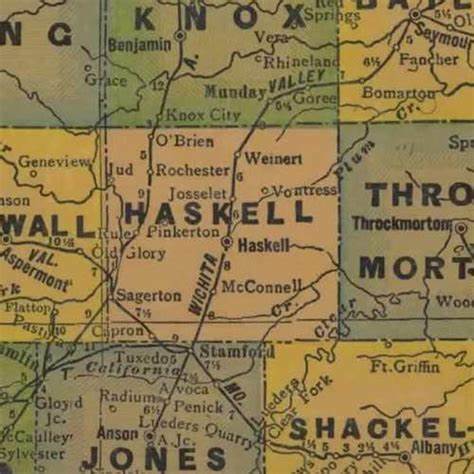
Sagerton
Sagerton, Texas, was platted on the Kansas City, Mexico and Orient Railway as it built through western Haskell County enroute to Mexico and the Pacific Ocean. In 1905, Mr. William Sager gave a tract of land for a townsite and depot. In 1909 a second rail line, the Stamford and Northwestern, came into town giving Sagerton the distinction of being the only community in Haskell County to once claim two rail depots. Citizens of Sagerton and the surrounding area each year come together to stage the Sagerton Hee-Haw, a production of music and comedy that showcases hometown talent. Visitors travel from throughout the south to enjoy sold out performances.
Rule
The town of Rule was founded in 1905 also as a result of the KCM&O Railway. Named for W.A. Rule, cashier of the National Bank of Commerce of Kansas City, Missouri, and treasurer of the Orient Railway, the town supports a bank, several churches and businesses. Beautiful murals display the artistic talent of local residents. Students of Rule ISD have placed their close-knit community permanently on the map through their exceptional academic and athletic achievement.
Rochester
When grading crews of the KCM&O surveyed the route through the western portion of Haskell County, the right of way bypassed the small community of Marcy. Realizing the potential the railroad held, citizens of Marcy moved churches, homes and businesses two miles east to relocate on the railroad. A.B. Carothers gave land for a townsite and contracted with the Orient to put in a depot and switches. They called the new town Rochester in honor of railroad director Arthur Stillwell’s hometown of Rochester, New York. Through its sandy soils and shallow water, Rochester has become known throughout Texas for its peanut production. The local buying point handles 10,000 tons annually.
O’Brien
O’Brien, Texas, was also platted along the KCM&O Railway in 1906. Originally named Carney after its founder, Tom Carney, the town’s name was changed to O’Brien in honor of the Texas manager of the Orient Railway, N.J. O’Brien. The town is home of the first state championship six-man football team. Situated near the northern county line, thousands of bales of Rolling Plains cotton are processed each fall in its state-of-the-art cotton gin. Farm Road 2229 running west towards the Brazos River provides incomparable vistas of West Texas sunsets behind Kiowa Peak.
Weinert
In 1906, F.C. Weinert founded the town 12 miles north of Haskell which bears his name. Originally established to ensure a strategic water supply for steam engines of the Wichita Valley Railroad, Weinert grew into an agricultural center supported by fertile soil and unsurpassed community spirit. Cowboys from nearby ranches added to the town’s colorful heritage as a West Texas railroad community. Throughout most of its history, activities revolved around its school system. Today, the schoolyard remains the center of the community, welcoming hundreds of visitors returning for homecomings and reunions.
Paint Creek
Seven miles southeast of Haskell is the community of Paint Creek. Formed from the consolidation of five school districts: Post, Howard, Weaver, Rose and McConnell, Paint Creek School was completed in 1937. Texas Governor Rick Perry is a graduate of this small community school located in the heart of farm and ranchlands of southeastern Haskell County. The area is rich in the colorful history of Indian battles with settlers and cavalry along nearby creeks.
Haskell
In the fall of 1882, the town of Rice Springs was established near the center of Haskell County. When petition was made for a post office, the town’s name was changed to Haskell. In 1885, it became the county seat. The Texas Central Railroad reached Haskell in 1906. Today, the town stands at the crossroads of two major Texas thoroughfares, U.S. Highways 380 and 277 and is the commercial center of the area.
***
The Star of the Big Country draws its brilliance from a variety of economic, recreational and community facets. As R.E. Sherrill writes in his History of Haskell County,
“. . .there was something about this country fresh from the hand of the Creator,
these grassy plains, these timbered creeks, a kind of drawing power
that was irresistible . . .”.
***
Excellent Water Supply
An excellent water supply is drawn from Lake Stamford and Millers Creek . Well water may be found generally at 75 feet through much of the county.
Diverse Agricultural Economy
The half million acres that make up Haskell County are as diverse in agricultural production as any in Texas. Cattle, cotton, wheat and grain sorghum are raised throughout the county. Shallow irrigation in the western portion allows the cultivation of peanuts, corn and alfalfa.
Petroleum
Oil was discovered in 1929 and became an important economic resource following World War II. To date Haskell County fields have produced over 100 million barrels.
Citizenship and Heritage
Haskell County residents are stewards of citizenship and heritage. Veterans’ memorials, museums, libraries, civic clubs and superior school systems are well supported by its communities. Members worship in a number of churches, several of which are over 100 years old.
Recreation
Lake Stamford provides excellent boating, fishing and relaxation opportunities. Hunters pursue an abundance and variety of game: quail, dove, deer, turkey, geese and wild hogs.

